Can I renovate my apartment on my own?
Can I renovate my apartment on my own?
Planning new electrical wiring so the sockets are finally within reach, thinking of chasing grooves in the bathroom or replacing an old floor? Stop. Unauthorised apartment renovations, and interventions in the structure above all, can cause more problems than they appear to at first sight. It is not only disagreements with the neighbours and the noise of the work itself that are at stake. There is also the risk of breaching the law and the requirements of the standards on acoustic comfort.
Structural stability is not the only problem an ill-considered renovation creates. Breaking into walls without a structural engineer's approval can lead to cracks, serious damage to the structure and a risk to safety — but serious problems connected with apartment renovations also concern acoustics. These are chiefly a worsening of the acoustic properties (impact sound insulation, airborne sound insulation) caused by weakening the structure.
Complications frequently arise when floor layers are replaced. A good floor build-up should include quality impact sound insulation, so that the neighbours below do not hear every movement we make. None of us wants to be constantly disturbed by other people's noise. If you do not lay an impact sound insulation underlay in the floor, sound travels easily through the structure and disturbs acoustic comfort. It is equally important to isolate every floor layer from the vertical structures with a movement joint, so that sound is not carried into the walls as vibration.
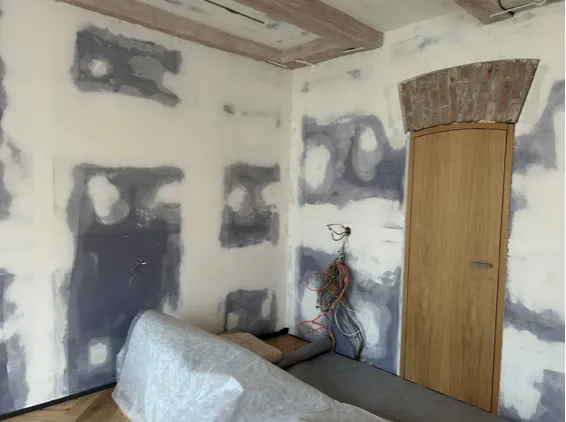
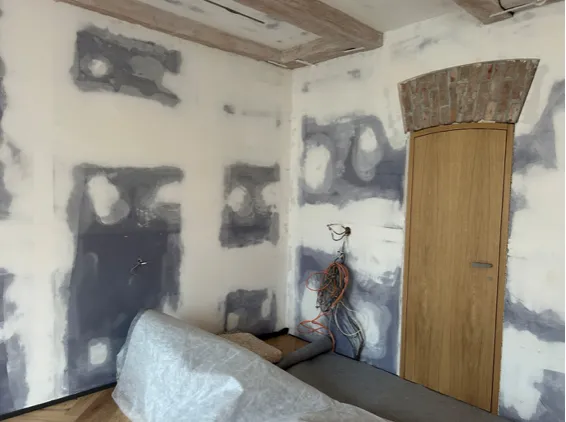
Sound insulation can also be weakened by chasing grooves, running water pipes and installing new sockets. You are looking forward to a new bathroom, and someone else will hear it every time you take a shower. Chasing grooves is a serious problem. A wall of a given thickness in your apartment is that thickness for a reason. If you simply reduce it by, say, a third by cutting a chase into it, its properties deteriorate too — and more markedly than it might seem. Think of it as a duvet you cover yourself with: if it has holes in it, it does not matter that it is intact in other places. You will still feel the cold.
Sockets are dangerous too, and not only because of the electricity. Acoustically they often represent a significant acoustic bridge. The wall is thinner where a socket sits. For acoustic protection it is therefore important to make sure that two sockets are not designed back to back. That prevents increased noise transmission and improves acoustic protection either within your own apartment or between your apartment and the one next door.
Even if we forget the neighbours for a moment, the requirements of STN 73 0532-2 apply to your apartment on its own account. Within one and the same apartment, the airborne sound insulation of internal dividing walls should be greater than 40 dB. Allow yourself the comfort — and if you already have it, do not reduce it.
Preventing acoustic faux pas during apartment renovations is simple: do not weaken structures without thinking it through, consult specialists instead, do not forget the impact sound insulation underlay when replacing floors, and leave a movement joint at the wall so that sound is not transmitted into the vertical structures. Protect yourself and everyone else from unwanted noise. That way you will genuinely be able to enjoy the renovation.